

Security clearance issues involving sexual behavior (Guideline D) are among the most sensitive and misunderstood concerns faced by federal employees, military personnel, and government contractors. While deeply personal, these matters can have serious implications for your ability to obtain or maintain a security clearance.
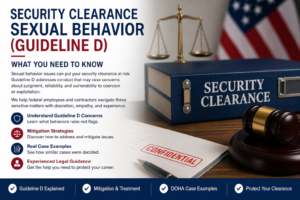
At Berry & Berry, PLLC, we regularly represent individuals navigating these complex situations with professionalism. This guide explains how Guideline D works, what adjudicators look for, and how concerns can be mitigated.
What Is Guideline D – Sexual Behavior?
Guideline D is part of the Adjudicative Guidelines under Security Executive Agent Directive 4 (SEAD 4). It addresses situations where sexual behavior may raise concerns about an individual’s:
- Judgment
- Reliability
- Trustworthiness
- Susceptibility to coercion or blackmail
As outlined in SEAD 4:
Sexual behavior is a concern when it involves criminal activity, poor judgment, or creates vulnerability to coercion, exploitation, or duress.
Importantly, sexual orientation alone is never a basis for denial. The government is focused on risk, not identity.
Why Sexual Behavior Matters in Security Clearance Cases
Security clearance determinations are fundamentally about risk management. Adjudicators are not moral arbiters, they assess whether your conduct could:
- Expose you to blackmail or coercion
- Reflect poor decision-making
- Indicate dishonesty or lack of candor
- Violate laws or regulations
Even private conduct can become relevant if it creates security vulnerabilities.
Common Sexual Behavior Issues That Trigger Clearance Concerns
While every case is unique, some recurring issues include:
- Undisclosed extramarital affairs
- Solicitation or payment for prostitution
- Viewing or possession of illegal pornography
- Inappropriate workplace conduct
- Secretive or undisclosed relationships
- Online sexual behavior (including messaging or content sharing)
These issues may arise during:
- Background investigations
- Polygraph examinations
- Self-reporting requirements
- Workplace complaints or incidents
Because these matters are highly personal, we approach every case with discretion, confidentiality, and empathy.
How Security Clearance Adjudicators Evaluate Sexual Behavior
Adjudicators look at the “whole person concept”, meaning they evaluate:
- The nature and seriousness of the conduct
- Frequency and recency
- Whether the behavior was voluntary or coerced
- Whether it was disclosed honestly
- Evidence of rehabilitation or change
The key question is not simply what happened, but:
👉 Does this behavior still pose a security risk today?
How to Mitigate Sexual Behavior Security Clearance Concerns
The good news is that many Guideline D cases are successfully mitigated. The goal is to demonstrate that the concern:
- Is no longer ongoing
- Does not reflect your current judgment
- Cannot be used to coerce or exploit you
Common Mitigation Strategies
Depending on the situation, mitigation may include:
- Demonstrating the conduct was isolated or occurred long ago
- Showing transparency (e.g., disclosure to spouse or employer)
- Providing evidence of counseling or treatment
- Obtaining evaluations from mental health professionals
- Proving there is no risk of blackmail or coercion
- Submitting character references and supporting documentation
For example:
- In extramarital affair cases, disclosure and counseling may help
- In prostitution-related cases, rehabilitation and time since the conduct are key
- In online conduct cases, demonstrating changed behavior and accountability is critical
Official Mitigating Factors Under SEAD 4
SEAD 4 provides specific mitigating conditions that may apply:
- The behavior occurred during adolescence and did not continue
- The conduct is remote in time or unlikely to recur
- The individual is not vulnerable to coercion or exploitation
- The behavior was private, consensual, and discreet
- The individual has completed or is engaged in treatment with a favorable prognosis
These factors are often central to building a successful defense.
Real Case Examples from the Defense Office of Hearings and Appeals (DOHA)
Understanding how these cases are decided can be helpful. Here are a few real-world examples:
❌ Clearance Denied
- Individual paid for prostitution multiple times over decades, including while holding a clearance
- Insufficient evidence of rehabilitation
- Subject to coercion because spouse is unaware
- Ongoing concerns about judgment
✅ Clearance Granted
- One-time solicitation of prostitution
- Immediate disclosure to employer
- Strong evidence of rehabilitation and good character
✅ Clearance Granted
- Accidental download of illegal content many years prior
- No pattern of behavior
- Successfully mitigated under other guidelines
❌ Clearance Denied
- Attempted non-consensual workplace misconduct
- Lack of mitigation and poor judgment
These cases show that context, honesty, and rehabilitation matter greatly.
The Importance of Honesty and Early Legal Guidance
One of the biggest mistakes individuals make is:
❌ Failing to disclose conduct
❌ Minimizing or misrepresenting facts
❌ Waiting too long to seek legal help
In many cases, the cover-up is worse than the conduct itself.
Working with an experienced security clearance attorney early in the process can significantly improve your outcome.
How We Can Help
At Berry & Berry, PLLC we understand how difficult and personal these cases can be. We provide:
- Confidential, judgment-free legal advice
- Strategic guidance tailored to your situation
- Representation in responding to the Statement of Reasons
- Representation in security clearance hearings and appeals
- Assistance with mitigation evidence and documentation
We have helped many clients retain or obtain their security clearances, even in challenging cases involving Guideline D.
Contact a Security Clearance Lawyer Today
If you are facing a security clearance issue involving sexual behavior, it is critical to act quickly and strategically. Early intervention can make a significant difference in protecting your career and clearance. Sexual behavior concerns under Guideline D are highly personal, but they are also legally manageable in many cases. With the right approach, documentation, and legal strategy, many individuals are able to successfully mitigate these concerns.
📞 Call us: (703) 668-0070
🌐 Visit: https://www.berrylegal.com

