

Federal employees who are serving a probationary or trial period often have fewer job protections than permanent federal employees. However, probationary status does not mean an employee has no rights at all. In certain situations, probationary employees may have legal protections, procedural rights, or alternative avenues to challenge an adverse action.
This article explains what probationary federal employees need to know about their rights, limitations, and potential legal options if they are facing termination or other adverse action.

What Is a Federal Probationary Period?
A probationary period is a trial phase of federal employment during which an agency evaluates an employee’s performance, conduct, and suitability for continued employment.
Competitive service employees generally serve a one-year probationary period
Excepted service employees may serve a trial period, which can be one or two years, depending on the appointment authority
Time spent as a contractor or intern typically does not count toward probation
Also, keep in mind that due to new Office of Personnel Management (OPM) regulations in June of 2025, probationary employees cannot move to full tenure status without affirmative approval by their agency. During the probationary period, agencies have broader discretion to remove employees than they do once probation is completed. However, some federal supervisors abuse this process and attempt to terminate employees not on actual merit, but personality dislike or illegal motives.
Can a Federal Agency Terminate a Probationary Employee?
Yes. In most cases, a federal agency may terminate a probationary employee with limited procedural requirements and without providing full appeal rights to the Merit Systems Protection Board (MSPB) or OPM. The probationary appeals process is currently pending transition from the MSPB to OPM based on recent OPM proposed rules.
Unlike permanent employees, probationary employees generally:
Are not entitled to advance notice of removal
Do not receive a formal opportunity to respond
Do not have full MSPB / OPM appeal rights
However, this discretion is not unlimited, and agencies must still follow applicable laws and regulations.
Do Probationary Employees Have Appeal Rights?
In general, probationary employees do not have MSPB or OPM appeal rights. However, there are important exceptions. Many of these rights and appeal procedures are being revised and may be undertaken by the OPM in the near future.
Limited MSPB or OPM Appeal Rights May Exist If:
The termination is based on pre-appointment reasons, such as alleged falsification of application materials or conduct that occurred before federal service
The termination is based on marital status or partisan political affiliation
In these narrow circumstances, a probationary employee might be able to file an MSPB appeal or OPM appeal (when the process is finalized) challenging whether the agency followed the law. Previously, these types of appeals were solely handled by the MSPB.
Other Legal Protections for Probationary Employees
Even when MSPB appeal rights are limited, probationary employees may still have other legal avenues available which may provide a better opportunity to litigate a wrongful probationary termination.
Equal Employment Opportunity (EEO) Rights
Probationary employees are protected from discrimination based on:
Race
Color
Religion
Sex (including pregnancy and gender identity)
National origin
Age (40 and over)
Disability
Genetic information
Retaliation for prior EEO activity
A probationary employee who believes their termination was discriminatory may pursue an EEO complaint, regardless of probationary status. Any new changes do not effect the EEO process.
Whistleblower Protections
Federal employees — including probationary employees — are protected from retaliation for making protected disclosures under the Whistleblower Protection Act.
Employees who believe they were terminated for whistleblowing may seek relief through the U.S. Office of Special Counsel (OSC) and ultimately the MSPB.
USERRA Protections
Federal employees in a probationary status are also protected against military discrimination. The Uniformed Services Employment and Reemployment Rights Act (USERRA) permit these individuals to appeal probationary terminations based on military discrimination. If the military discrimination claim arises under USERRA, the MSPB has jurisdiction regardless of probationary status.
Common Agency Mistakes During Probationary Terminations
Agencies sometimes make errors that affect a probationary employee’s rights, including:
Terminating an employee whose probation has already ended
Improperly classifying the employee’s appointment status
Failing to follow required procedures for pre-appointment removals
Terminating an employee based on whistleblowing
- Terminating an employee based on illegal discrimination
These issues can significantly affect whether appeal rights exist.
Examples
Example 1: An employee removed for alleged resume falsification may be entitled to appeal to either the MSPB or OPM.
Example 2: An employee terminated shortly after filing an EEO complaint may have a retaliation claim.
- Example 3: An employee discloses fraud and is terminated in their probationary period as retaliation.
Each case depends on its specific facts and timing.
Changes Likely Ahead in 2026 and Beyond
As noted, new changes have been proposed by the Government in regards to attempt to limit or change probationary rights. These new policies started in 2025 and have been proposed for 2026. Expect additional changes to the probationary appeals process in the future. It is expected that OPM will take on more of the probationary period appeals in the future. These changes do not affect discrimination or whistleblower appeals involving probationary employees.
Frequently Asked Questions
How long is a federal probationary period?
Most competitive service employees serve a one-year probationary period, but some excepted service positions require a longer trial period. Additionally, an agency must affirmatively approve the transition from probationary to tenured employee.
Can a probationary employee appeal a termination to the MSPB or OPM?
Usually no — but limited MSPB or OPM appeals may be available in specific circumstances, and other legal claims may still exist like EEO or Whistleblower complaints.
Does probationary status mean I have no rights?
No. While rights are limited, probationary employees are still protected from discrimination, retaliation, and certain prohibited personnel practices.
Why Legal Guidance Matters
Because probationary rights are limited, currently changing and highly technical, timing and classification issues are critical. Employees may lose potential claims simply by missing deadlines or misunderstanding their status.
An experienced federal employment attorney can help determine whether:
- OPM appeals exist if MSPB appeals do not
An EEO or OSC claim is appropriate
The agency followed required procedures
Conclusion
Federal probationary employees have fewer protections than permanent employees, but they are not without rights. Understanding the scope and limits of those rights is essential when facing termination or other adverse actions.
If you believe your probationary termination violated federal law or merit system principles, seeking timely legal advice may help protect your interests.
Our speciality is defending federal employees against disciplinary actions.

Approximately 20,000 federal employees are subject to disciplinary actions a year. Our nationwide federal employee lawyers represent federal employees in these disciplinary cases before their federal agencies. Each disciplinary action defense is unique and should be evaluated by attorneys familiar with federal employment law.
Defending Thousands of Federal Employees Over the Past 25 Years in Disciplinary Cases
There are different types of disciplinary actions for federal employees. These vary and can include letters of counseling, reprimands, suspensions, demotions, and removals. For most serious disciplinary actions, referred to as adverse actions (usually removals), a federal employee first receives a notice of the proposed discipline and is given the opportunity to respond. A proposal will have an explanation of the conduct or issues leading to the proposed disciplinary action.
If a federal employee is issued a notice of proposed disciplinary action, they will have the opportunity to contest it before it becomes final. Most permanent federal employees (past their probationary period) are entitled to significant due process rights. In responding, a federal employee can choose to provide a written response, an oral response, or both. We often recommend providing both oral and written responses.
Request Disciplinary Materials (Materials Relied Upon)
In most disciplinary cases, it is important for federal employees to request all of the materials that have been relied upon by the agency in proposing the discipline. Sometimes these are attached to the proposal, and other times they must be requested separately. We request these materials before responding on behalf of federal employees at the beginning of a case. These materials provide the basis for the proposed disciplinary action.
Draft a Written Response
It is important to prepare a complete written response to the allegations in proposed disciplinary cases. These responses are typically 7 to 20 pages in length, depending on the underlying facts and number of charges and specifications. Most written responses are typically due anywhere from 7 to 30 days after a proposal is provided to a federal employee.
The written response will address the alleged charges of misconduct or performance and any relevant mitigating factors (also known as the Douglas factors). In our responses, we also provide available evidence that contradicts the charges. Additionally, we attach declarations, affidavits, good performance records, character support letters, and other helpful exhibits.
Presenting the Oral Response
The oral response portion of a federal employee’s response can be very important. While written responses can be critical in refuting specific allegations, there is something very important about personally meeting with a Deciding Official that is making the decision. We think that in serious cases, oral responses can make a significant difference in outcomes. We represent federal employees during oral responses. Typically, during an oral response, the federal employee, their attorney, and the Deciding Official (often with their counsel) will be present. The attorney and federal employee will get a chance to argue against the disciplinary action directly to the decisionmaker.
After the oral response, there is usually a few weeks to a few months until a decision is made on the proposed discipline. During that time, there is also the possibility that attorneys from both sides can resolve the discipline through settlement.
Appeals from Adverse Disciplinary Decisions
If an unjust disciplinary decision is sustained by a federal agency, there are various options for federal employees to appeal further. If serious enough, an individual can appeal to the Merit Systems Protection Board (MSPB). Other potential appeals can include filing Equal Employment Opportunity complaints or whistleblower appeals, where applicable. There are also a number of other types of appeals that may be brought, but legal advice is important when making such decisions.
Reach Out to a Federal Employee Lawyer
When a federal employee receives or anticipates a proposed disciplinary action, it is important to have an attorney represent or advise them from the beginning. Our lawyers represent federal employees nationwide in all types of federal employee discipline. We can be contacted at www.berrylegal.com or by telephone at (703) 668-0070.
We represent Virginia employees in employment matters. When an employer seeks to use a polygraph examination in an employment context you may need legal advice. We are often asked about whether or not a Virginia employer can require an applicant or employee to take a polygraph examination in regards to hiring or retention decisions. The answer, while generally no, has a number of implications for both Virginia employees and employers. It is important to obtain legal counsel on these issues prior to taking a polygraph examination when issues arise.

This article discusses some of the issues that can arise in the context of attempting to require Virginia employees to take a polygraph examination related to their employment.
For Virginia employees, there are both federal and state restrictions on polygraph usage. It is important to know both areas of law.
What is the Employee Polygraph Protection Act
On the federal level, Congress enacted the Employee Polygraph Protection Act, 29 U.S.C. §§ 2001- 2009 (EPPA of Polygraph Act). The EPPA provides for strict limits on the use of polygraphs in the workplace for employees and applicants. The EPPA bars most types of employers in Virginia (and other states) from requiring or even suggesting that a current employee or job applicant take a polygraph examination. The law also prohibits employers from utilizing the results of any polygraph examination.
The EPPA does not necessarily apply to Virginia employees who work for Federal, State and local governments. Polygraph examinations can also often be part of the legal processing of a federal security clearance. It also does not apply to private sector employees engaged in security-related activities (e.g. Security Guard, Armored car services). The Polygraph Act also permits polygraph testing, subject to restriction, of certain types of employees who are reasonably suspected of involvement in workplace theft or embezzlement that resulted in an economic loss to the employer. The Department of Labor has provided a good summary of the law under the EPPA act here.
When are Polygraph Examinations Permitted for Virginia Employees?
When polygraph examinations are permitted for private sector employees in Virginia, there are numerous strict rules that most be followed. These include “including the right to a written notice before testing, the right to refuse or discontinue a test, and the right not to have test results disclosed to unauthorized persons.”
The courts in Virginia, federal and state, have not had occasion to rule on these issues too often, but these cases likely get resolved early due to employer liability. Harmon v. CB Squared Servs., 624 F. Supp. 2d 459, 472-472) (E.D.Va., Jan. 29, 2009) (Former employee was asked to submit to polygraph examination by employer and was told that his examination revealed deception; employer not granted dismissal of case because facts show that the employer had violated EPPA by causing the employee to take a polygraph examination and by referring to the results of the examination at the meeting to discuss the test results).
Should an employer be found liable by a court under the EPPA for not following the law regarding polygraph use, the employer can be held liable for: (1) penalties up to $10,000; (2) lost wages, benefits and (3) attorney’s fees. There is also equitable relief where an individual can seek reinstatement or lost promotions as a result of the violations of the EPPA. In other words, employers need to be extremely careful when considering the use of polygraph examinations under the EPPA.
Virginia State Polygraph Protections
In the Commonwealth of Virginia, there are also additional protections for employees with regards to polygraph examinations. Pursuant to the Virginia Code, the only major restriction on employer polygraph testing in Virginia involves the subject matter of such testing. Virginia bars questions about an applicant’s prior sexual activities unless it is related to a conviction of such a criminal violation of the laws of Virginia.
The 1977 Virginia law, in Va. Code Ann. § 40.1-51.4:3, titled the Prohibition of use of certain questions on polygraph tests for employment, states as follows:
Contact Us
One of the more usual types of federal employee retirement matters that our firm handles involves the representation of federal employees in the disability retirement process before various federal agencies and the Office of Personnel Management (OPM). Federal employees thinking about filing for disability retirement should consider the following issues as they debate whether or not to proceed with an application for disability retirement.

How Serious are the Federal Employee’s Medical Disabilities and are They Linked to Duties in Their Position Description?
When making a federal employee disability retirement decision OPM evaluates a federal employee’s continued ability to work with their medical condition in the context of the duties described in their position description. OPM uses the phrase “useful and efficient service in your current position” to describe the degree to which a federal employee can carry out their job duties. Basically, the issue is whether or not the medical issue or disability prohibits a federal employee from performing their current duties. This is distinguished from being too disabled to work any position.
If the medical disability is not considered serious enough, or not fully supported by medical documentation and evidence, then OPM may deny the disability retirement application. However, there is a lot that a federal retirement attorney can do to increase the chances of submitting a successful application.
How Long is the Medical Disability Expected to Last?
The duration of a medical disability is very important when OPM makes a disability retirement decision. OPM generally requires that a medical disability be expected to last at least 1 year in duration. When considering whether to file for disability retirement, it is important for a federal employee to consider the expected length of the individual’s medical disability. Disabilities with shorter durations can be problematic for federal employees in the disability retirement process and could result in the denial of the application.
Does the Federal Employee’s Case Fall Under the Bruner Presumption?
It is quite often the case that a federal employee may be facing removal or potential removal related to their disability. If so, that can provide strong support for approval of a disability retirement application by OPM. This is often referred to as the Bruner presumption, after the case of Bruner v. OPM. Essentially, the Bruner case stands for the proposition that if a federal agency removes a federal employee for the medical inability to perform their duties than the Agency must disprove an employee’s entitlement.
Can the Federal Employee Survive on a Reduced Annuity?
If a federal employee is considering filing for OPM disability retirement, it is important to understand that this type of retirement can provide a federal employee with a lower monthly retirement annuity in comparison to full retirement at full years of service and age. Therefore, we recommend that a federal employee consults with a financial advisor about the impact of a potentially reduced annuity before filing for disability retirement. The very good news is that an individual approved for disability retirement can generally work again in the private sector (or for state or other local governments) (not in other federal employment positions) and supplement their income (usually up to 80% of their prior salary) without losing their disability retirement income.
Are There Reasonable Accommodations that can be Made to Allow the Federal Employee to Continue to Work?
Sometimes a federal agency will work with an employee to provide them with a reasonable accommodation (RA) (i.e., change in duties, assignments, hours, telework or other adjustments) that can make the employee’s current position and medical condition workable and thereby avoid the disability retirement process. This, however, has its limitations.
As a part of the OPM disability retirement process, a federal agency is required to certify that it is unable to accommodate your disabling medical condition in their present position. The federal agency must also certify that it has considered a federal employee “for any vacant position in the same agency, at the same grade or pay level, and within the same commuting area, for which [you] qualified for reassignment.” Federal agencies typically do not have an issue with such certifications and generally assist federal employees who are seeking disciplinary retirement.
Does the Federal Employee have Medical Support for Disability Retirement?
For federal employees, proper medical documentation and evidence is the most important consideration when filing for disability retirement. We also find that physicians will usually help their patients in the disability retirement process. When OPM reviews disability retirement applications, they rely heavily on a federal employee’s medical evidence. As a result, physicians and their medical opinions are crucial in the disability retirement application process with OPM.
OPM will require physicians’ statements about a federal employee’s medical issues, and these physician statements can either make or break the potential success in the disability retirement application process. It is important for a physician to understand a federal employee’s position description and how their disabilities interfere with their duties. It is also not that uncommon for a federal employee to be told by their physician that they should consider disability retirement.
Does the Federal Employee Have Enough Time in Service to be Eligible for Disability Retirement?
Generally, most federal employees fall under FERS, which only requires 18 months of creditable federal service before one is eligible for disability retirement. For those in the CSRS system, then 5 years of federal service is required prior to eligibility. Most individuals fall under FERS and generally have the ability to file for OPM disability retirement.
Does the Federal Employee Have Time to File for Disability Retirement?
Federal employees must file for disability retirement within 1 year of separation from federal employment. This is critical. There are some very rare exceptions, but OPM must have a federal employee’s application in hand within that 1-year period or there is a substantial risk of denial on that basis alone.
Contact Us
If you are in need of assistance in the federal employee disability retirement process please contact our office at 703-668-0070 or through our contact page to schedule a consultation.
Our federal employment lawyers represent federal employees in the different grievance processes. Most, if not all federal agencies have their own federal employee grievance procedures for employees who wish to bring employment disputes forward for resolution. 
Why Federal Employees Use the Grievance Process
Generally, federal employees utilize a federal agency’s grievance process when it is the most appropriate place to file an appeal. For example, a federal employee may decide to file an administrative grievance if their employment dispute does not qualify for an Equal Employment Opportunity (EEO) complaint, the appeals process at the Merit Systems Protection Board (MSPB) or before other forums.
What are the Different Types of Federal Employee Grievances?
There are usually two types of federal employee grievances: (1) a union grievances; and (2) individual administrative grievances. Typically, federal employees who are not eligible for the union grievance process use the administrative grievance process. These individuals generally file federal administrative grievances. Those federal employees represented by a labor union may be required to go through the union grievance process. We have represented individuals in both types of grievances. They are similar except that union grievances have the potential to ultimately go to arbitration. This article mainly focuses on administrative grievances.
What do Administrative Grievances Cover?
Administrative grievances filed by federal employees involve various types of employment disputes. For example, an administrative grievance can involve a challenge to a disciplinary action (example: Letter of Warning, Suspension), a performance action, a re-assignment or other employment issue. There are numerous types of disputes eligible for the administrative grievance process for federal employees. For most grievances, it is important to retain an experienced federal employment lawyer to prepare the response.
How Does the Administrative Grievance Process Work?
When considering filing an administrative grievance it is important to review the applicable administrative grievance process for your federal agency. Attached is a sample agency policy here. Every federal agency has its own administrative grievance procedures. Many administrative grievance policies require that a federal employee notify a supervisor verbally of the administrative grievance prior to filing a written grievance. Other policies require that a written grievance be submitted first.
Depending on the federal agency, an administrative grievance process typically consists of 2-4 steps. Usually, at each step, the federal employee and a grievance official will attempt to resolve the grievance. Often the written grievance is submitted first and a secondary in-person meeting is then held to present the administrative grievance. It is critical to ensure that you follow the deadlines for each step or the grievance may be dismissed. Usually, at the end of a grievance presentation the federal employee, often through counsel, will present a compromise resolution proposal. Following the administrative grievance presentation, the employee or counsel will receive a written decision on the grievance. If an initial administrative grievance is denied, then the federal employee will often have the ability to proceed to the next higher step of the process.
What if a Grievance is Denied?
If an administrative grievance is denied, some federal agencies provide additional rights for review and others do not. As mentioned above, there can be 2-4 steps in the grievance process for federal employees. If the grievance is originally denied, then a second step grievance can usually be filed with the supervisor of the step 1 official. There are some federal agencies that offer federal employees a hearing process for administrative grievances and many others that do not. It is important to understand how the applicable administrative grievance procedure works for a particular federal agency prior to starting the process. Each federal agency is different and it is important to obtain and follow the applicable grievance procedures.
Contact Us
When a federal employee is considering filing an administrative grievance, it is important to have an attorney represent or advise you. Our law firm represents federal employees in the administrative grievance process. If you are a federal employee in need of legal representation please contact our office at 703-668-0070 or through our contact page to schedule a consultation.
Understanding and applying the Douglas factors in federal employee disciplinary cases are critical. Our federal employment law attorneys represent federal employees in disciplinary actions. Douglas factors play a critical role in federal employee defense. There are typically two parts to a federal employee’s disciplinary case: (1) whether the federal employee committed the offense(s) charged; and (2) if so, what should the penalty be? One of the most important issues in defending a federal employee in a disciplinary case involves arguing for mitigation of the penalty. Arguing for mitigation generally means that we argue for the application of the Douglas Factors in attempting to mitigate (or reduce) disciplinary penalties issued in a case.
What are the Douglas Factors?
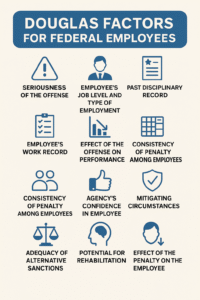
The Douglas factors, in federal employee cases, are also referred to generally as mitigating factors. These factors are used to argue that disciplinary charges for federal employees, even if true, should still result in a lower penalty than the one proposed. The Douglas factors originate from the case of Douglas v. VA, 5 MSPR 280, 5 MSPB 313 (1981).
In Douglas, the Merit Systems Protection Board (MSPB) established 12 different factors that should be considered by a deciding official when evaluating the reasonableness of a disciplinary penalty for a federal employee. When our firm prepares an MSPB appeal for a federal employee client or in a case before a deciding official at the proposal stage it is important to understand all potential mitigating factors that might be applicable to a federal employee’s case. The Douglas factors can be used as mitigating or aggravating factors so it is important to fully understand the application of both types of legal arguments. In sum, it is critical for federal employees to understand the Douglas factors or to have counsel that does.
The following is a list of 12 Douglas factors that should be taken under consideration if a disciplinary action is warranted with explanations as to how they can apply to a particular federal employee case.
The 12 Douglas Factors
(1) The nature and seriousness of the offense and its relation to the employee’s duties, position, and responsibilities including whether the offense was intentional, technical, or inadvertent; was committed maliciously or for gain; or was frequently repeated.
The first Douglas factor, nature and seriousness of the offense, generally refers to the connection between the seriousness of the allegation and the position that an individual federal employee holds. This has often been considered one of the most important Douglas factors by the MSPB. For example, an allegation of dishonesty would be treated more seriously, under this Douglas factor, for a federal employee that holds a supervisory position. The first Douglas factor also looks at whether an allegation is part of a pattern of similar conduct (i.e. a repeat offense) and whether the misconduct at issue was intentional. Generally, this Douglas factor one tends to be used more by a federal agency to aggravate (increase) the proposed disciplinary penalty in a given case.
(2) The employee’s job level and type of employment, including supervisory or fiduciary role, contacts with the public, and prominence of the position.
The second Douglas factor for federal employees involves the level of federal employee a case involves. It is traditionally used to attempt to aggravate a disciplinary penalty, as opposed to mitigate one. For example, a federal agency may attempt to use the particular position that a federal employee holds (e.g., high-level supervisor, such as GS-15) or type of position (e.g., law enforcement) as an aggravating factor. Many agencies may attempt to overplay their hand with this Douglas factor, but the MSPB will typically assess a position based on their own evaluation in some cases.
(3) The employee’s past disciplinary record.
The third Douglas factor involves an evaluation of a federal employee’s past record. The use of a federal employee’s past disciplinary record is one of the more commonly cited Douglas factors. We argue this Douglas factor in many cases. This factor is generally used for purposes of mitigation unless an employee has a past disciplinary action, which is cited. Generally, however, this Douglas factor is argued for the purposes of arguing for a less severe penalty.
For instance, if the federal employee at issue has worked for the federal agency involved for 25 years and has never received prior discipline during that time this can be used as an argument in mitigating the disciplinary penalty. For example, one could argue that given the lack of prior discipline that a proposed removal should be mitigated to a suspension action. Sometimes, this third Douglas factor may be confused by federal agencies who attempt to aggravate a disciplinary penalty by basing it on previous misconduct that is not similar to the current action.
(4) The employee’s past work record, including length of service, performance on the job, ability to get along with fellow workers, and dependability.
The fourth Douglas factor is one of the most often used arguments we use in support of mitigation of a disciplinary penalty. Generally, this argument is used by a federal employee to support a reduction in penalty based on their good record of service to their agency (e.g. past performance). For instance, in the disciplinary cases that we handle we might attempt to seek mitigation of a proposed disciplinary penalty by arguing that an employee’s outstanding performance (e.g., performance ratings, commendations/awards and letters from supervisors/co-workers) during their years of service support a reduction in a disciplinary penalty. Essentially, you are arguing that the proposed penalty should be mitigated based on having a good employment record.
It is important to argue Douglas factor four with supporting documentary evidence (e.g., commendations, awards, copies of performance records, letters of commendation, letters about performance by supervisors or members of the public, letters of support) as you move forward.
(5) The effect of the offense upon the employee’s ability to perform at a satisfactory level and its effect upon supervisors’ confidence in the employee’s work ability to perform assigned duties.
Loss of supervisory confidence as a Douglas factor is typically used by Federal agencies in serious disciplinary actions to issue a more serious disciplinary penalty. This Douglas factor can be extremely helpful for purposes of mitigation where a federal employee has continued to work successfully in their normal position (i.e., not placed in light duty or administrative leave), over an extended period of time after the underlying allegation has occurred and been known. The argument for mitigation here is that the federal employee continued to work in their normal position while the investigation was ongoing so that they must have been trustworthy.
(6) Consistency of the penalty with those imposed upon other employees for the same or similar offenses.
This Douglas factor comes into play when an agency picks and chooses different penalties for similar level federal employees. This occurs quite often. Usually the root cause of different treatment in terms of disciplinary penalties tends to be favoritism by a federal agency between different federal employees. However, it is important to argue this Douglas factor where a prior federal employee case of a similar nature resulted in a lower disciplinary penalty. For example, in this type of case we would argue that you cannot issue a light penalty (e.g., 7-day suspension) for one federal employee and propose a 60-day suspension for another employee where the nature of the alleged conduct is so similar.
(7) Consistency of the penalty with any applicable agency table of penalties.
Federal agencies may attempt to base a proposed or final penalty on an agency’s table of penalties. A federal agency’s table of penalties is typically a table with lists of individual offenses and the ranges of possible penalties for such offenses. Generally, the ranges of penalties are fairly broad (e.g., Letter of Reprimand to Proposed Removal). We generally find that it is important to actually make sure that a proposed or a sustained final penalty has been listed appropriately under the agency’s table of penalties. On occasion, we have found that the agency has not followed their table of penalties or has listed the misconduct under the wrong offense in their table.
(8) The notoriety of the offense or its impact upon the reputation of the agency.
This Douglas factor generally involves how much the public has been advised of a federal employee’s alleged misconduct. Typically, this factor is used by an agency to support an increase in the proposed disciplinary penalty. Generally, this factor comes into play when a federal employee’s alleged misconduct has been reported by the media or in social media. We have also seen federal agencies use this Douglas factor to aggravate disciplinary penalties where other agencies (federal, state, local) have become aware of a federal employee’s misconduct, arguing that the employee’s actions have caused the federal agency’s reputation to somehow become tarnished. It is important to rebut these issues in a Douglas factor defense.
(9) The clarity with which the employee was on notice of any rules that were violated in committing the offense, or had been warned about the conduct in question.
The ninth Douglas factor is important and is used in many cases where the policy that has been allegedly violated is not clear. The “lack of clarity” argument refers to the rules governing the underlying allegations at issue. Typically, a federal employee will be proposed for disciplinary action in a case based on a violation of a particular agency policy. It can often be the case that a federal employee has been charged with a violation of agency rules but has not been properly trained with respect to these rules or regulations.
As a result, in defense cases our firm attempts to argue that the lack of clarity as to these rules warrants a reduction in a disciplinary penalty. For example, we might argue that the lack of a clear agency policy on Internet usage should result in mitigation of a penalty for an employee that has been charged with misuse of a government resources.
(10) The potential for the employee’s rehabilitation.
The potential for an employee’s rehabilitation is an important Douglas factor for a federal employee, especially in cases of proposed removal. While some federal agencies attempt to use this Douglas factor in an effort to attempt to increase a federal employee’s disciplinary penalty, we have found that this factor is extremely helpful for purposes of a reduction in the employee’s penalty. For instance, if an employee has committed misconduct but fully discloses his or her actions prior to an investigator finding out about the misconduct, this can be deemed to be a significant mitigating factor.
Or in another case, if an employee has continued to work in their position over the course of a long period of time after the allegations are under investigation, this shows that the Agency continues to have trust in the employee and that the employee has continued to perform well despite the initial allegation. We argue this factor, in most cases, to attempt to reduce a proposed removal to a lower form of disciplinary action.
(11) Mitigating circumstances surrounding the offense such as unusual job tensions, personality problems, mental impairment, or harassment; or bad faith, malice or provocation on the part of others involved in the matter.
This Douglas factor tends to be a general mitigation factor that can incorporate many different types of arguments for mitigating a penalty. If a mitigation argument does not fit under the other 11 Douglas factors, it can, in most instances, be argued here. Our firm often uses this Douglas factor to highlight personality conflicts in issuing proposed discipline by the proposing official or harassment by others in the workplace which led to the proposed discipline against a federal employee.
Other times, when there are medical issues related to the offense we can use this argument to attempt to mitigate the proposed penalty. Some federal employees have successfully argued for mitigation where stress or an anxiety condition contributed to the disciplinary misconduct issues. This is the most important Douglas factor for federal employees that we see.
(12) The adequacy and effectiveness of alternative sanctions to deter such conduct in the future by the employee or others.
While not often used that often by federal agencies in their final decisions, this Douglas factor can and should be argued in significant disciplinary cases (e.g., proposed removals or significant suspension cases). We have argued, in cases for federal employees, that a different penalty (i.e., other than the one proposed by an agency) is more than adequate in a certain case and still serve the same disciplinary purpose as a more steep penalty.
For instance, we have argued that instead of removing a federal employee that they should instead receive a suspension. In another example, where a federal employee has been placed in an unpaid suspension over the course of several months while an investigation was pending, we would argue that this should be considered as part of the penalty served so that the ultimate penalty issued should be reduced. For this Douglas factor there are a number of ways in which to argue that a reduced penalty would serve the same purpose as something more serious (e.g. removal).
Contact Us
Douglas factors are critical for federal employees defending against pending disciplinary actions or during the course of an MSPB appeal. As a result, it is very important for a federal employee to argue all relevant Douglas factors and provide documentary evidence (e.g. declarations, affidavits, performance ratings, SF-50s, letters of commendation) for the record.
Douglas factor issues vary significantly from case to case and federal employees should consult with an attorney who is knowledgeable about these issues prior to responding to a proposed disciplinary action or filing an appeal with the MSPB. Mitigation of a removal penalty can often save a federal employee’s career and avoid termination or forced retirement.
Berry & Berry, PLLC represents federal employees in these types of federal employment matters and can be contacted at (703) 668-0070 or www.berrylegal.com to arrange for an initial consultation regarding Douglas factor and other federal employment issues.

An interesting topic in Virginia employment law involves an employee’s right to privacy within the workplace. While there have not yet been many specific laws enacted by the Commonwealth of Virginia governing employee rights in the workplace, this area of law is developing and changing almost as fast as technology is. In light of the advancements in monitoring technology available to employers, it is only a matter of time before we see more employee privacy issues addressed by the Virginia Legislature and our court system.
Thoughts on Employee Use of Employer Computers
In general, for a number of reasons we recommend that employees avoid using employer technology to conduct their own personal business. Virginia employers have been given a fair amount of leeway under existing laws to monitor employees in the workplace which means that employers can attempt access in reviewing their own computers and networks.
Regarding this issue, one of the biggest concerns that we have run across in representing employees in wrongful termination cases in Virginia involves an employee’s use or alleged misuse of an employer’s email, computers, network or Internet. Frequently, one of the first actions taken by an employer following a contentious termination is to conduct an examination of a former employee’s computer or prior Internet usage. The usual result is that the employer often claims that the former employee was conducting personal business or misusing the employer’s network. An employer may then claim that the employee violated Virginia’s Computer Crime Act, VA. Code § 18.2-152.3 or misappropriation or theft of trade secrets.
The best way for an employee to avoid these types of issues from arising either during or after employment is to not use the employer’s computer or network for any personal business. While it can be inconvenient to consult legal counsel over these types os issues with employers, it can also be very costly to get it wrong and pay the costs of legal defense when an employer wants to pursue a former employee in some way.
Email and Internet Monitoring of Employees
Employers that monitor employee email or Internet use should obtain legal advice ahead of time to avoid the risk of running afoul of criminal and other statutes. This cannot be overemphasized. That said, an employer in Virginia typically has the ability to monitor emails and Internet usage on their own networks. Employers should warn employees about monitoring in advance. We usually advise employees that they should expect that their work email account may be monitored and should not be used for personal business even if they have not been so informed of a company’s decision to monitor email.
Employers also need to be careful to avoid accessing employee private, non-work email accounts to which they may have access. For example, an employer should avoid attempting to inappropriately log into a former employee’s private email account that remains accessible from the employee’s former computer. Virginia also has enacted the Virginia Computer Invasion of Privacy Law. If an employer does something egregious in the course of monitoring email or Internet usage, then it could be subject to a potential claim under this law or perhaps a tort (personal injury) claim.
VA Code § 18.2-152.5 provides for privacy protections for all individuals for unauthorized access. Specifically, the privacy provisions of the Virginia Code provide that:
A person is guilty of the crime of computer invasion of privacy when he uses a computer or computer network and intentionally examines without authority any employment, salary, credit or any other financial or identifying information, as defined in clauses (iii) through (xiii) of subsection C of § 18.2-186.3, relating to any other person. “Examination” under this section requires the offender to review the information relating to any other person after the time at which the offender knows or should know that he is without authority to view the information displayed.
Telephone and Voice Mail
Some employers also monitor work-related employee telephone calls. A Virginia employer who wants to monitor telephone calls of an employee or voice mail messages must usually warn the employee in advance and the monitoring must be done in the scope of normal business. This is often accomplished by the employer at the beginning of employment, through policies listed in an employment contract or handbook. There are many pitfalls in monitoring telephone calls and voice mails of employees and this ideally should be done after receiving legal advice given that potential criminal issues could result if done incorrectly under both federal and Virginia wiretapping laws.
Security Camera Monitoring of Employees
With the widespread use and availability of small wireless cameras, a number of employers have attempted to monitor their employees using such technology. The courts have generally upheld an employer’s right to monitor its employees with security cameras so long as the monitoring is not particularly invasive. This has not yet been subject of major litigation in Virginia but it is no doubt forthcoming. In other jurisdictions, some courts have upheld employee privacy rights in situations where camera monitoring of employees has been very invasive such as with cameras in locker rooms or bathrooms. Many courts have permitted the use of such camera monitoring to the extent that employees are aware of it and can see the cameras, and that it is not misused.
Finally, Virginia does not yet recognize the traditional claim of invasion of privacy, which could help in employee rights claims when an employer goes too far. However, serious breaches of employee privacy can result in other types of tort claims for intentional infliction of emotional distress. Virginia case law and national trends continue to change and more employment rights and the ability to sue for egregious privacy violations are likely to develop in the future.
Social Media
In Virginia, state law puts prohibitions on employers attempting to inject themselves into an employee’s social media accounts. VA Code § 40.1-28.7:5 prohibits employers from seeking an employee’s social media login credentials or requiring an employee to add an employee, supervisor, or administrator to their social media contacts associated with their accounts.
Microchipping Employees as a Form of Monitoring
While definitely a potentially future issue, at least 1 employer was in the news for offering employees a microchip to facilitate employer tasks. Three Square Market, a technology company in Wisconsin asked workers to consent to having a microchip, about the size of a grain of rice implanted between their thumb and forefinger. Approximately 50 of the 80 company employees agreed to this procedure. The microchip will allow employees to check into work, access computers, open doors and purchase company food and drink.
This is clearly a major issue coming down the road, but is likely to take a number of years to develop through litigation. For instance, it could easily be the case where states vote to ban such a practice, in advance, or otherwise regulate it. For now, it is just something to keep in mind for the future.
Employee Monitoring Cases Nationally
While Virginia has not been subject to too many employment cases as of yet involving employee monitoring, the issue has reached a number of other states. a U.S. District Court has held that employees have no reasonable expectation of privacy even when employers have promised it. In Smyth v. Pillsbury, 914 F.Supp. 97 (E.D.Pa. 1996), the court ruled that an employer could read personal e-mails even when it had told employees it would not.
The U.S. Supreme Court, in Quon v. City of Ontario, 130 S. Ct. 2619 (2010), held that a police officer, through his department issued device had no expectation of privacy in his text messages, even though his commanding officer had promised him that his messages would not be monitored. In Quon, the Court held that the officer should have ignored what his commanding officer told him and relied upon the boilerplate language in a form he was given with the device.
Contact Us
If you need assistance with Virginia employment law issues or issues involving the use of employee monitoring, please contact our office at (703) 668-0070 or here to schedule a consultation.
 We represent Virginia employees in non-compete agreement issues. Non-compete agreements and clauses are important for employees to consider in joining or leaving an employer. Northern Virginia, given its proximity to Washington, DC, has numerous businesses engaged in government contracting. Given this fact, and the fact that these types of businesses tend to be very competitive, there has been a significant rise in the number of employees that are required to sign non-competition or “non-compete” agreements as part of their employment requirements. Over the past 10 years or so, we have noticed that businesses in Virginia are using “non-compete” agreements in their hiring processes far more than before. The rise in non-compete agreements in Virginia has not been limited to just government contractor positions, but also includes many types of other businesses as well ranging in size from small to large. At the same time, the laws regarding non-compete rules are evolving in Virginia and elsewhere.
What is a Non-Compete Agreement?
A non-compete agreement is merely a written agreement where an employee agrees not to leave an employer and then compete for the same business when they leave that employment. Typically, non-compete clauses are inserted in employment agreements by an employer during the hiring process and have become somewhat commonplace. Common characteristics of non-compete agreements include duration of the non-competition period, limits as to competition for certain customers and the geographic boundaries of the non-competition area. If you work in Virginia and have signed a non-compete agreement with your employer, former employees can face legal issues if they violate them. That is why it is important to get legal help in negotiating these agreements and attempting to resolve issues that later arise from alleged violations by an employer.
Types of Issues That Arise in Virginia Non-Compete Agreements
There are any number of issues that can arise because of a non-compete agreement or clause in Virginia. An employer may accuse a former employee of violating the prior agreement. In such cases, hiring a Virginia employment attorney is critical to resolve the issues before they get into court. Non-compete agreements in the Commonwealth of Virginia tend to be viewed as somewhat disfavored and have been viewed somewhat negatively as a type of restraint on business. As a result, in Virginia, non-compete agreements have a better chance of success, if enforcement is attempted, the more narrowly tailored they are. Courts in Virginia will enforce reasonable non-compete agreements. Non-compete agreements, in this narrow sense, must be prepared to: (1) protect a bona fide employer’s interest; (2) must be reasonable; and (3) must not be against public policy. There are a number of specific features that come into play in Virginia with respect to these 3 variables. Typically, a valid business interest is considered the extent to which a non-compete agreement protects the employer from poaching existing customers, trade secrets, or other confidential information.
Non-Compete Agreements Should be Narrow
Keeping in mind that these types of non-compete agreements must be drafted narrowly, courts in Virginia will not enforce agreements that are overbroad or unreasonable. Some pitfalls in non-compete agreements include the following: (1) agreements that impose overbroad geographical limitations (i.e. a prohibition on competing in the United States where the service area is only a portion of Virginia); (2) unreasonable time constraints (i.e. a 20-year restriction; although each determination is based on the individual facts of a case); (3) agreements prohibiting an employee from working in any capacity for a competitor; (4) agreements whose terms and not clear or discernible; (5) agreements for licensed professionals (physicians, lawyers, etc.) which may be barred on public policy grounds; and (6) agreements that unfairly burden an employee’s ability to obtain alternative employment. The bottom line is that employers should be reasonable in drafting non-compete agreements for employees.
Other potential issues with non-compete agreements exist and it is important for an employer to structure a clear and fair non-compete agreement in order for it to be upheld by the Virginia courts. It is important for an employee to understand their obligations as well. Since July 1, 2020, with a change in law, Virginia has prohibited employers from entering into, enforcing or threatening to enforce non-compete agreements with low wage employees. The definition of low-wage employee changes based on the Commonwealth’s average weekly wage. A good case to review by the Virginia Supreme Court on these issues can be found at this link. Additionally, the federal government may or may not be successful in attempting to further reduce the ability of some employers to use non-compete agreements for employees in the future. As mentioned above, this area of law is in the process of evolving.
Obtain Legal Advice from Virginia Non-Compete Lawyers About Non-Compete Agreements
When negotiating a non-compete agreement or clause or when questions arise as a result of a non-compete agreement it is very important to seek an experienced Virginia employment lawyer. This is best accomplished prior to signing an agreement or when potential violations arise. Our law firm represents employees and businesses with respect to non-compete agreements. We can be contacted at www.berrylegal.com for legal advice and consultation in such matters.

Importance of Workplace Investigations
When serious allegations arise in the Virginia workplace, it is very important for an employer to retain a neutral and knowledgable investigator. This is especially so with respect to sexual harassment allegations, where such employer action can be required. Employers are faced with numerous legal risks if they do not conduct an investigation or otherwise fail to adequately investigate the behavior of their employees. For instance, in addition to sexual harassment and discrimination claims, other claims for negligent hiring and retention are being brought in larger numbers. Additionally, a workplace investigation may involve a whistleblower complaint and must be addressed. As a result, employers conduct investigations far more regularly in Virginia than they have in the past.
Purpose of Workplace Investigations
The purpose of workplace investigations is for an employer to gather relevant evidence. The do so to determine the validity of the complaint. If it is based on an employee’s alleged misconduct, the purpose is to determine whether the misconduct warrants a disciplinary or an adverse action (e.g., termination or significant suspension) within the requirements established by law, policy, or regulation or with respect to the employer’s own liability. Occasionally, these types of investigations can lead to a potential criminal investigation. Depending on whether the employer is federal, public sector or a private employer, a supervisor or other designated investigator may be asked to conduct an investigation regarding the facts at issue.
Employees may then be asked to provide verbal or written responses to questions regarding the alleged misconduct. Additionally, an investigation can result in various consequences, such as termination, suspension or loss of a security clearance, where applicable. The purpose in an employment discrimination investigation is to determine whether or not the allegations are credible.
Hiring an Investigator
Once a workplace investigation is required, the next step is for the employer to identify who will conduct the investigation as the investigator. Government employers generally have their own investigators (e.g. Office of Inspector General) and merely assign one or two investigators to a case to evaluate the conduct of employees. However, in the private sector (which covers the vast majority of employees) an investigator must be hired to conduct the investigation. This task is often completed by hiring a law firm and designating an attorney to conduct the administrative investigation. Many law firms conduct these types of investigations. Our firm typically only represents employees in investigations where the employer seeks to question them. There are numerous other law firms that represent employers in these matters. When being interviewed by an employer’s lawyer it is critical to have your own attorney.
Employee Duty to Cooperate
During an investigation, an investigator (i.e. the law firm) will be hired to conduct a workplace investigation. They will review documents (e.g. complaints, emails, documents) related to the investigation and interview witnesses. Depending on the breadth of the investigation, it can involve interviews of numerous employees. Employees, depending on their particular employer, may have a duty to fully cooperate with an assigned investigator. They may also be able to decline to participate in the investigation unless they are ordered to participate. For example, some Virginia employees may decline to participate in an administrative investigation if it is voluntary. The investigator may also order a complete search of the employee’s computer and work emails.
Refusing to cooperate with an investigation or providing false statements or answers during an investigation can be grounds for disciplinary action. Providing false statements, if made to a federal or other law enforcement investigator, can also subject an employee to potential criminal penalties. For private sector employees in Virginia, not cooperating in an employment investigation can lead to disciplinary action or termination in some cases.
Employer Risks in Not Conducting Investigations
Internal or administrative investigations can also involve risks for the employer. If claims are made by employees, inadequate workplace investigations may raise questions regarding the accuracy of the results or whether the employee was treated fairly. In addition, the employer may not like what the investigation uncovers and will have an obligation to resolve or address issues, such as a systemic problem or legal impropriety. Additionally, as mentioned above, if an investigation is not undertaken an employer can be potentially liable for their negligence of complicity in not addressing the workplace issues.
Consider Legal Advice and Representation
Prior to providing information to an employer, depending on the severity of the issues under investigation, it can be important for an employee to discuss with an attorney the issues involved. It is important to determine the scope of the investigation and what legal issues may come into play for the employee. Keep in mind that an investigation being conducted by a private employer’s lawyer is likely looking for misconduct. The employer generally is not looking for reasons to exonerate the employee. An attorney familiar with administrative or internal investigations can provide legal advice to assist an employee in preparation for responding to questions about his or her actions in the matter being investigated. In addition, an attorney, in many circumstances, can often accompany the employee during any investigative interviews.
Contact Us
Security Clearance Representation Nationwide
Welcome to the law firm of Berry and Berry, PLLC in the Metropolitan, Washington D.C. area. We specialize in the nationwide legal representation of individuals in security clearance matters. We have represented thousands of clients across the country in their security clearance matters for over 25 years. Our goal is to work hard for our clients in attempting to help them keep or obtain their security clearances. Our firm represents security clearance holders or applicants in different areas of the country, or even internationally, to defend them. We represent security clearance applicants at all levels, including Secret, Top Secret, Sensitive Compartmented Information (SCI), Special Access Programs (SAP), Yankee White and others. We also defend these individuals in suitability or public trust appeals which are slightly different but involve many of the same principles.
Security Clearance Assistance Available
We provide legal advice and representation to federal employees, military personnel and government contractors regarding their security clearances. We represent clearance applicants and holders at all steps of the security clearance process, from legal advice prior to completing their initial clearance questionnaires (SF-86) to the final steps of the security clearance appeals process. Our lawyers represent clearance holders and applicants before all federal agencies. We also specialize in representing security clearance clients before Intelligence Community agencies. Our goal is to represent individuals vigorously before security clearance authorities. At the same time, we understand that many security clearance cases involve sensitive issues. Discussions with attorneys in the firm are privileged and confidential.
Additionally, we realize that security clearance issues can happen to anyone and treat our clients with respect no matter what the issues involve. Given the changes in technology, it is easier than ever, to represent individuals nationwide. In the past, we might have had to fly to a location across the country to represent an individual in a security clearance hearing, the Government has incorporated Microsoft Teams and Zoom for many security clearance proceedings. This has made it easier than ever to represent clients no matter where they live and work.
Types of Nationwide Security Clearance Defense Available
There are many different types of issues where we can represent security clearance clients nationwide. Some of the areas where our security clearance attorneys assist individuals include:
- Pre-application Guidance (SF-86 or electronic forms);
- Investigative Interview Guidance;
- Polygraph Considerations;
- Responses to Security Clearance Interrogatories;
- Responses to Statement of Reasons or Notices of Intent to Revoke;
- Representation in Security Clearance Written Responses; and
- Representation in Security Clearance Personal Appearances before Administrative Judges and Adjudicators.
Security Clearance Background of Firm
Our lawyers are extremely experienced in security clearance law. The law firm’s founder, John V. Berry, Esq. teaches other attorneys about the security clearance process through lawyer continuing legal education courses in multiple states. Our firm has multiple attorneys who are very experienced in representing individuals in security clearance matters. We are also members of the Security Clearance Lawyers Association. You can also visit our security clearance blog where we cover and review legal issues for clearance holders and applicants. Furthermore, please review our website resources for helpful information about the security clearance process.
Contact Us
Our security clearance lawyers represent individuals throughout the United States. We would be happy to meet and try to assist you with your security clearance matter. Please contact Berry & Berry, PLLC to schedule a consultation with a security clearance attorney. You should feel free to contact us at (703) 668-0070 or through our contact page should you wish to schedule a time to discuss your individual security clearance issues. We would be honored to go over your security clearance issues and attempt to find a solution for you.

